Author Archive

Catholic Views on Cremation

July 22nd, 2011

Burying the dead goes back to the early Christian times. The early Catholic Church openly forbid cremation for centuries because of the belief that the body is a temple of the Holy Spirit. Cremation was seen as a pagan practice that denied the doctrine and faith in resurrection. Early Catholicism viewed burial as a symbol of  hope for resurrection, as well as a continuance of early Christian traditions.
Only in the last 50 years has Catholicism accepted cremation as a means of final disposition. In 1963 the Vatican lifted the ban on cremation for Catholics. Cremation then became a practice allowed under certain  circumstances, providing that the reasons did not counter Christian beliefs.

The Church once used very strict rules for funeral services and sacraments in the event of cremation. The Church did not allow cremated remains (also known as cremains) to be present in the church during the celebration of mass or any prayer vigil. The body had to be present for all services before cremation.

The Order of Catholic Funerals was three separate, and ideally, sequential rites to celebrate the end of one’s life in the flesh, and the beginning of a new one in spirit:

  • Prayer Vigil – a short prayer service that takes place during the time immediately following death.
  • Mass – a celebration in the funeral liturgy.
  • Rite of Committal – another short prayer service held at the cemetery or place of internment.

The ideal sequence of the three is: the vigil, funeral mass and then the rite of committal.

In 1997, the Vatican granted permission for cremated remains to be present for mass and  rite of committal, making Catholic cremation more openly available to families in need. The Church still recommends traditional burial. However, Catholic cremation has quickly gained popularity, and is seemingly necessary for many Catholic families. The reasons for cremation differ, but cost is by far the most common.

Keeping with The Church’s traditions of the sacredness of human life, there are still strict rules on the sanctity of human ashes:

  • The cremated human remains (cremains) shouldn’t be scattered, divided among family or kept at a home.
  • Cremains should be treated with respect, and laid to rest in a cemetery, either in a grave or mausoleum.

According to the Cremation Association of North America cremation rates in the United States have risen from 5% (from nearly 20 years ago) to 39-45% as of 2008. It is estimated that Catholic cremation has risen to approximately 15-20% in the last ten years.

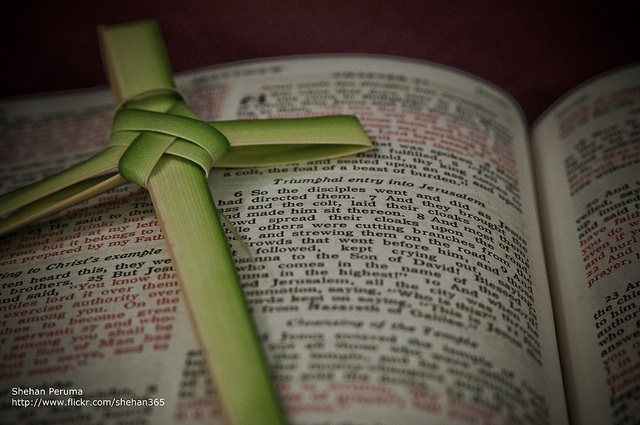
Special Thank you to Shehan365 For the beautiful picture via Flickr.
Hispanic Funeral Traditions

July 20th, 2011

The funeral traditions of the Spanish-speaking cultures are similar, but have many differences and variations from each other. For the purpose of this article, we are generalizing the similarities of customs rooted in Hispanic cultures to give you a brief description of what to expect at a Hispanic Funeral.

Hispanic Funeral Traditions Are Primarily Catholic

Because of the how deeply-rooted Catholicism is in Hispanic heritages, even non-Catholics include Catholic traditions in their funerals.

The Hispanic culture accepts death as part of life. It is the end of the life in the flesh, and a beginning of the life in spirit. Catholic Hispanics celebrate one’s death, because the soul is going “home” once the body has died. The funeral process doesn’t begin after death, but before one passes.

  • Whenever the situation allows, the funeral process begins on the death-bed. A priest will give the dying person their Last Rites, which consist of confession (if possible), communion and pastoral blessing.
  • A family member will stay with the body of the deceased until the preparations begin for the funeral services.
  • A traditional Hispanic Funeral will consist of 3-4 days of services and vigils to honor and pray for the departed soul.
  • A Catholic Priest will lead the services for the funeral. Starting with the wake.

Continue reading “Hispanic Funeral Traditions” »

The Thin Line Between Grief and Depression

July 18th, 2011

Grief and Depression go hand in hand when it comes to losing a loved one. Losing a loved one affects not only our mind, but our body as well. Our mind and body work together and react to the loss as a threat. Grief is just the minds way of coping with the threat.

Thin Line Between Grief & Depression People who are grieving often become withdrawn from the world and although grief is a natural and healthy reaction, it can be become very serious and even threatening to your physical health. It can be hard to tell the difference between the depression that comes along with grief and clinic depression, but the more you know about the signs and symptoms, the easier it will be for you to understand and take action when needed.

Speaking to someone who is grieving can be emotional, and often times things can feel awkward. It is very important to be honest and supportive to someone in grief; to offer a listening ear and a helping hand. Acting natural and calm while letting them know how much you care for them, will help ease the pain. Encouraging them to talk about and express their emotions and feelings will help heal the wounds of grief.

A few things to be avoided when talking with someone in grief

  • Don’t avoid them
  • Don’t pry. If they don’t want to talk, don’t force it.
  • Don’t ask for details about the person’s death.
  • Don’t offer advice with quick solutions.
  • Don’t try to cheer up or distract them.
  • Don’t minimize their loss. (Example: “You will move on”, “He is in a better place.”, “You can always re-marry”. Even though these things might be true, it is not something the grieving person wants to hear.)

Continue reading “The Thin Line Between Grief and Depression” »

Traditional Asian Funeral Etiquette

July 16th, 2011

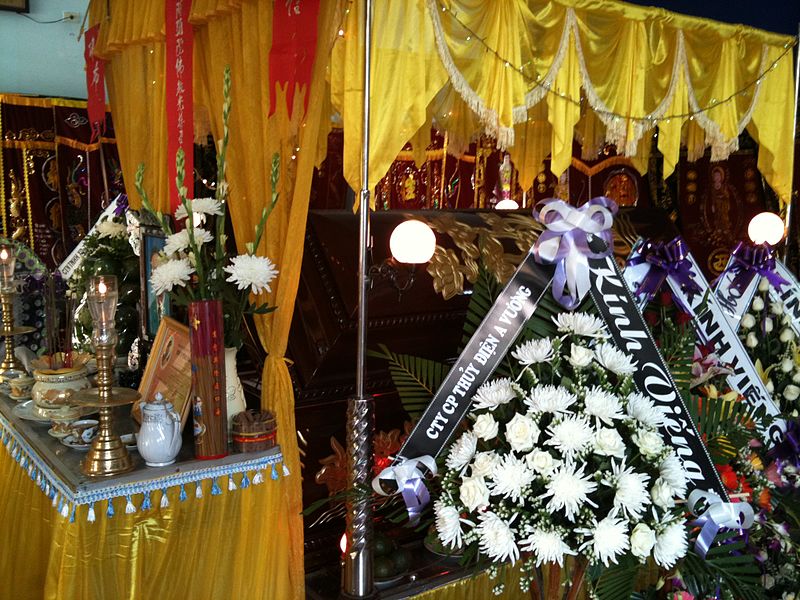
Asian Funeral with Alter

Funeral customs vary greatly in the Asian culture.  The following article refers mostly to traditional Chinese funeral customs.  

If you are attending an Asian Funeral, there are a few rules of etiquette that are very important to follow. The burial process of someone who has passed is taken very seriously in Chinese society. Asian culture teaches that someone who is buried without the proper funeral customs will bring bad luck and disaster to the family. Cremation among traditional Asians is very rare.

Asian culture uses beauty and respect throughout their funeral services. Every detail is covered and has special meaning behind it. The traditions they use have been passed from generation to generation to make the end-of-life transition more beautiful.

What To Expect When Attending An Asian Funeral

The funeral process and rites are based on how traditional the family is, as well as age, social status, and marital status.

Tradition teaches that an elder is not to show respect to someone who is younger. So, if the funeral is for a younger person, their body cannot be brought home (as is custom for an older person). This also goes for an infant or child. The services will be held at the funeral parlor, in a way similar to western funerals.  Since no respect can be shown, there are no vigils, prayers or offerings made, the service and burial will be made in silence.

Wake or Viewing at An Asian Funeral

Traditional Asian funerals will be held at the home of the deceased. If the death occurred inside the home, the casket and service will be held inside. If the death occurred outside of the home, the casket and service will be in a courtyard near the home. Wreaths, flowers and a picture of the deceased will sit on top of the coffin.

Traditional funerals last for 49 days, with the first 7 being the most important. However, if the family doesn’t have the financial means, the funeral will last 3-5 days with the first day being the most significant.
Continue reading “Traditional Asian Funeral Etiquette” »

Estate Planning Glossary

July 14th, 2011

The terminology used in Estate Planning can be confusing if you are not familiar with the wording used.  Estate lawyers/attorneys are equipped to help through the process, but it is also a good idea to be well-informed before hand.

Glossary of Estate and Probate Terminology

A

Administration: The time when the personal representative collects the deceased assets, pays debt and distributes the estate as arranged in will.

Administrator: The personal representative (if there is a will). The person assigned by the court to distribute the deceased assets if there is no will. Also known as the executor/executrix.

Affidavit: Sworn/written statement constructed under oath with witnesses.

Annual Exclusion: The amount of gifts allowed annually to be given to family members free of federal taxes.

Asset Protection: The act of protecting your estate during your life and after death from any legal or tax problems.

Attorney In Fact: The person assigned as agent under power of  attorney.

B

Beneficiary: The person(s) who receives the benefit property/estate or trust.

Bequest: To leave a gift or property as noted in a will.

Continue reading “Estate Planning Glossary” »

Choosing and Personalizing a Grave Monument

July 12th, 2011
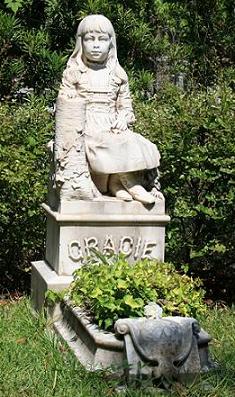
Little Girl Statue Grave Marker - Gracie

Gracie Statue Monument

Choosing and designing a monument for your loved one is a very important step in the grieving process, and your last expression of love during this sorrowful period.

The headstone or monument is a tribute to their life. It’s a visual remembrance. It tells the story of their life, ensuring that for years to come, they will be remembered.

What Is the Purpose Of Cemetery Monuments & Headstones?

Cemetery headstones and monuments are more than just a way to mark the grave site. Throughout history, cemetery monuments have told the story of a person’s life.

Included on the monuments could be a statement of character, their interests, place of birth and place of death of the deceased. How many children the person had, how they died, a Bible verse, a poem or even special quotes are also displayed on burial markers.

The essence of the deceased is forever captured by placing these insights on their grave monument. Families display this information on cemetery monuments as a lasting tribute to their loved ones.

Words are not the only way to personalize a monument for a lasting memorial. Statues, mausoleums, grave benches and plaques can create a sense of how esteemed the deceased was to their community, family or nation.

In the Bonaventure Cemetery in Savannah GA, two families memorialized the life of their daughters with statue monuments. The headstones for Little Gracie and Corinne are life-like statues, created to replicate their image as it was in life.

Continue reading “Choosing and Personalizing a Grave Monument” »

Dealing With the Violent Death of Someone You Love

July 12th, 2011

Losing someone in a sudden death is both frightening and unsettling.  Deep emotional stress and confusion surrounds the first few hours and days after a loss. Knowing what to do and being prepared can benefit you immensely during this troubled time.

First Things First

  • Notify Police
  • Officers may leave written information with details about the prosecutor, medical examiner, place of hospital for the deceased and a victims advocate.
  • A family member might be asked to identify the body of the deceased
  • Personal belongings of your loved one might be used as evidence for later in the prosecution. If you wish to claim any of the items, tell the officer leading the case.
  • A forensic autopsy might be required to gather evidence
  • After the identification and autopsy, the medical examiner will arrange transportation of the body to the funeral home the family has selected.

Incident Information Report includes the following:

  • Case number
  • Date and Time of incident
  • Name of officer investigating the incident along with the officer’s contact information
  • Name of the officer who will be contacting the family of the victim
  • Name of the coroner and their contact information
  • Location of the Deceased and contact information for the

If you feel the urge to ask, to get more information, or be more involved during the process of the investigation, don’t hesitate to ask. You are not alone, and you shouldn’t scared to ask the officers or departments of those who are working with your case.

In the mean time, you will need to contact a funeral home to make the arrangements for the service. A funeral director will work with the family to coordinate the service with the needs of the family. They will likely ask for the specifics from an autopsy, if one is performed, and whether or not an open or closed casket will be proper.
The funeral director will also be able to answer any questions you have about transportation of the body to and from the funeral home.

When someone dies as the result of a crime, the police as well as a coroner might be involved.  When the death turns into a criminal investigation, the proceedings for this can take some time. Working with your local law enforcement will help to keep you involved and informed during the investigation.

What To Expect At A Funeral

July 10th, 2011

Funerals are always a difficult and emotional occasion. Many people get nervous or anxious when attending a funeral. There are some basic principles when it comes to one’s behavior and etiquette throughout the funeral process.

Condolence Visits

If you are a close friend or family member of the deceased, it is proper to pay a visit to the home of the family members before the funeral, to offer your help and share fond memories.

Before a Wake

A wake is a time when family and close friends come together before a funeral to spend time in remembrance of the deceased. Many people will offer to bring food, watch children, clean house or help with any of the planning.

Expressing Your Sympathy

Sending flowers to the church, funeral home or the family’s home is a well-known way of expressing your sympathy. When words can’t say it, flowers will show it.

Continue reading “What To Expect At A Funeral” »

Dealing With An Unexpected Death

July 8th, 2011

When an unexpected death occurs, the family and loved ones are caught off guard. Not knowing what to do or where to turn can fuel the fire of grief and confusion. We have accumulated critical information for the families that are dealing with the passing of a loved one, to help you through the process.

An unexpected death brings uncertainty and often requires an autopsy to determine the cause of death. When an autopsy is preformed, it will usually take place on the same day or the day after.

Viewing the body of the deceased before an autopsy may be possible in certain circumstances, yet there are times when the family is not able to until after the autopsy has taken place for forensic purposes. If this is the case, the body will be released to the funeral home after the autopsy.

While this process can be frustrating, it is a necessary action that needs to take place in the event of an unexpected death. Take comfort in knowing that the funeral home and funeral director will work through this process with you to help heal the pain and sadness during this difficult time.

How to Handle an Automobile Casualty

July 6th, 2011

When a loved one dies, life suddenly becomes very confusing and frustrating. On top of the grief, emotions and sadness, you now are in the process of planning and arranging a funeral service. This time may be extremely overwhelming, and often times many issues might be overlooked because of the rush.

We are here to help. We have outlined a few topics that are very important when it comes to a sudden death by the way of  automobile accidents.

When a fatality has occurred in a car accident, an incident report is created by officials. It will contain very important information.

Some of the details included will be:

  • Case Number
  • Date and Time of Incident
  • Name of Information of the Investigating Officer
  • Officer notifying family members
  • Coroner’s Information
  • The location of the deceased
  • Police hold and location of vehicle

You will be given information about the location of your loved one. Depending on the severity of the situation, there are different routes that might be taken.

Typically the body is transported to the coroner who was at the scene. If an autopsy is necessary, the body of the deceased may be transported to a pathologist.

If an autopsy is necessary, the coroner or county attorney will be able to make arrangements for the family members to view the deceased body before the autopsy. Once the arrangements and autopsy are preformed, the body is then transported to the funeral home.

When dealing with an automobile accident, the vehicle will probably contain personal belongings. The towing company can remove them for you, or a family member might be able to retrieve them. If  law enforcement has put a hold on the vehicle, there might be  a delay in the process.

Continue reading “How to Handle an Automobile Casualty” »